Tenants Face Challenges With ESA Letter Acceptance in March 2026
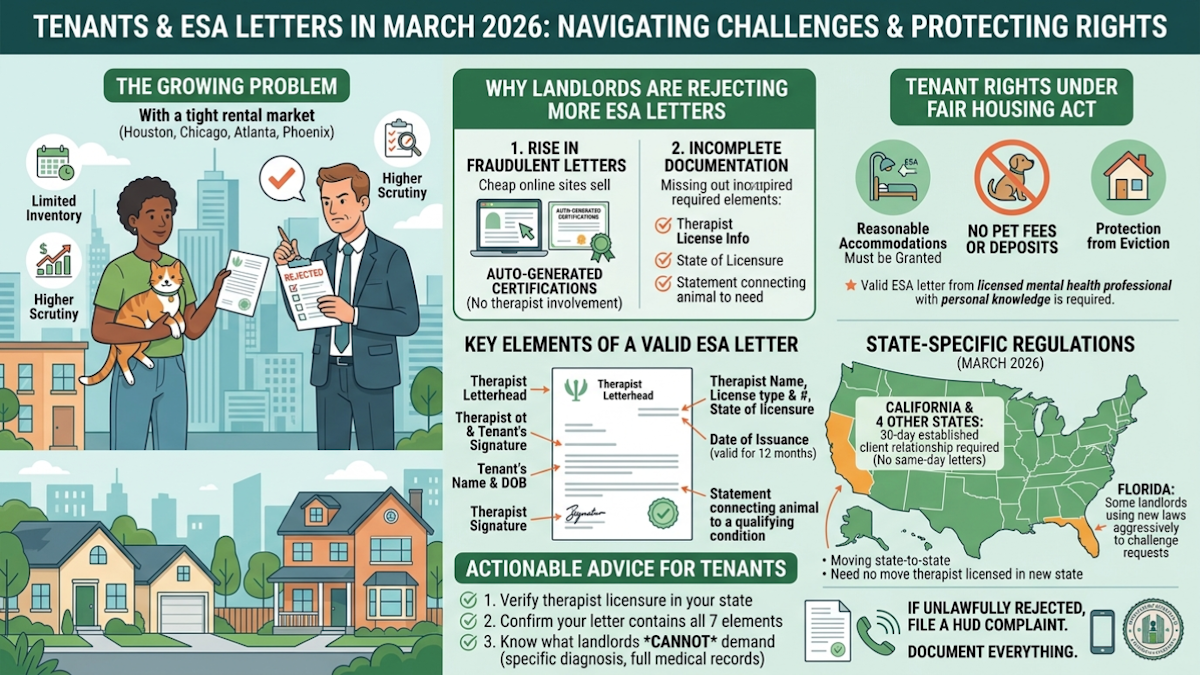
Across the United States, renters with emotional support animals are running into a growing number of roadblocks when submitting ESA documentation to landlords this spring. From rejected letters issued by unlicensed online platforms to property managers demanding more paperwork than federal law requires, tenants report that securing housing with an ESA has become more stressful in March 2026 than ever before. Advocates and telehealth providers are urging renters to understand their rights and verify the legitimacy of their documentation before applying.
The spike in acceptance issues comes as rental inventory tightens in major metros including Houston, Chicago, Atlanta, and Phoenix. Competition for units means property managers face higher scrutiny from owners and HOA boards, some of whom are pushing back on ESA accommodation requests. Tenants caught in the middle often lack the legal knowledge to push back effectively, leaving them vulnerable to delays or denials that federal law does not permit.
Why Landlords Are Rejecting More ESA Letters in 2026
Property managers cite two primary reasons for increased rejections this year. First, a flood of fraudulent ESA documentation from unregulated online "certification" mills has made landlords suspicious of all digital letters. Second, many tenants are submitting letters that lack required elements under HUD Notice FHEO-2020-01, such as the therapist's license number, state of licensure, and a clear statement connecting the animal to a qualifying mental health condition.
Under the Fair Housing Act, landlords and housing providers must grant reasonable accommodations for tenants with legitimate ESA letters issued by licensed mental health professionals. The law prohibits charging pet fees or deposits for emotional support animals and protects qualifying tenants from eviction based solely on the presence of their ESA. However, these protections only apply when the tenant holds valid documentation from a licensed mental health professional who has personal knowledge of their disability-related need.
HUD guidance is clear that a blanket "no-pets" policy does not override a valid accommodation request. Yet tenant advocacy groups in states including California, Texas, Florida, and New York report that some landlords are testing this boundary in 2026, apparently banking on tenants not filing formal complaints with state housing agencies or the Department of Housing and Urban Development.
The Fake Letter Problem Fueling Landlord Skepticism
One of the most damaging trends driving landlord pushback is the proliferation of fake ESA letters sold online without any clinical evaluation. These documents, often sold for as little as $20 to $30, claim to certify animals as emotional support animals through automated questionnaires with no licensed therapist involvement. Because these letters look similar to legitimate ones on the surface, property managers have grown increasingly cautious about all ESA documentation regardless of actual source.
The consequences fall hardest on tenants with genuine mental health needs. When a landlord flags a letter as suspicious, the burden shifts to the tenant to prove authenticity. Tenants who obtained their letters from non-compliant sources have no recourse because their documentation does not meet federal standards. Those who paid for fraudulent letters not only lose housing opportunities but also face difficulty requesting refunds from disreputable providers who make no legally binding guarantees.
RealESALetter.com, a telehealth platform that has issued more than 20,000 ESA letters across all 50 states, reports that landlord verification calls to their team have increased significantly in early 2026. The company's letters are issued by state-licensed mental health professionals including LMFTs, LCSWs, LPCs, and psychologists, and include direct verification contact information so property managers can confirm authenticity quickly. Their platform also offers a 100% money-back guarantee if a letter is not accepted, with a formal HUD complaint pathway available for tenants whose valid documentation is unlawfully rejected.
State-Specific Rules Adding Complexity
Several states have added compliance layers beyond federal requirements, creating additional confusion for tenants in March 2026. California's AB 468 requires a 30-day established client-provider relationship before a licensed therapist can issue an ESA letter, meaning same-day approval services are legally non-compliant for California residents. Arkansas, Iowa, Louisiana, and Montana have similar minimum relationship period requirements. Tenants in these states who obtain letters from out-of-state providers or services that ignore these rules risk having their documentation rejected outright.
Understanding ESA laws by state has become essential for renters in 2026. What qualifies as compliant documentation in Nevada may not satisfy requirements in California or Montana. Tenants relocating across state lines mid-lease often discover their existing letters need renewal or re-issuance by a therapist licensed in their new state, a requirement many were not warned about when they originally obtained their documentation.
Florida tenants face a separate challenge this spring. Following 2023 legislative changes under HB 837, landlords gained broader tools to challenge suspected fraudulent ESA requests. Some landlords in Miami, Orlando, and Tampa are using this framework more aggressively than intended, requesting detailed medical histories that tenants are not legally required to provide. Housing attorneys in the state have noted a rise in consultation requests from confused renters unsure of what they must disclose and what they can lawfully decline to share.
What Tenants Can Do Right Now
Legal advocates recommend three immediate steps for any renter facing ESA documentation challenges in March 2026. First, verify that your ESA letter was issued by a licensed mental health professional with an active license in your state. A letter from an out-of-state or unlicensed provider will not withstand landlord scrutiny. Second, confirm your letter contains all required elements: therapist's name, license number, state of licensure, your name and date of birth, date of issuance, therapist's signature, and a statement connecting the animal to your qualifying condition.
Third, know what landlords cannot legally demand. Under HUD guidelines, a housing provider may request reliable documentation confirming a disability-related need for the accommodation, but they cannot require your specific diagnosis, full medical records, or information that goes beyond confirming the need and nexus between your condition and your ESA. Tenants who receive invasive or unlawful documentation requests should document the communication and consult a fair housing advocate.
Tenants whose valid letters are rejected have formal recourse through HUD's Fair Housing complaint process, which requires landlords to respond to investigations and can result in civil penalties. Filing a complaint preserves legal rights and creates a record that housing providers have learned to take seriously. Platforms like RealESALetter.com provide direct support through this process, including assistance preparing complaint documentation when a compliant letter is unlawfully denied.
Verification Technology Changing the Landscape
Property management firms are increasingly using third-party screening tools to flag ESA letters in their intake process. Some platforms cross-reference provider names against state licensing databases in real time, instantly identifying letters from unlicensed individuals or fabricated credentials. While this technology benefits tenants with legitimate documentation by accelerating verification, it creates new problems for those whose letters come from providers whose licenses have lapsed or who operate in non-compliant states.
Telehealth ESA services that maintain active state licensing for their therapist networks are better positioned in this environment. RealESALetter.com's model of matching each applicant with a therapist holding a current license in the applicant's state means their letters pass automated screening checks that reject letters from providers without state-specific credentials. This technical alignment with HUD requirements reduces the likelihood of delays during property management intake reviews.
Frequently Asked Questions
Can a landlord legally reject my ESA letter in 2026?
Yes, but only under specific limited conditions. The Fair Housing Act allows landlords to reject documentation that lacks required elements, comes from an unlicensed source, or fails to demonstrate a nexus between your qualifying condition and your need for an emotional support animal. A blanket refusal based on a no-pets policy, breed, or size is not a legal basis for rejection when valid documentation is presented.
What should an ESA letter include to be accepted by landlords?
A valid ESA letter must be issued on the therapist's professional letterhead and include their full name, license type, license number, state of licensure, your name, date of birth, date of issuance, signature, and a statement confirming that an emotional support animal is part of your treatment plan. Missing any of these elements gives landlords grounds to question the letter's validity.
Does my ESA letter expire and do I need to renew it in 2026?
Most ESA letters remain valid for 12 months from the issuance date. Landlords can request updated documentation at lease renewal. Tenants should set renewal reminders 30 days before their letter expires to avoid gaps in coverage during active housing searches or lease transitions.
What can I do if my landlord demands my full medical records?
You are not required to provide your medical records or specific diagnosis to a landlord. Federal law requires only that you demonstrate a disability-related need and a connection between that need and your ESA. If a landlord demands records beyond what HUD guidelines allow, document the request and consult a fair housing advocate or file a complaint with HUD.
Where can I get a legitimate ESA letter that landlords will accept?
Seek out telehealth services that verify therapist licensing in your specific state and comply with state-specific requirements like California's AB 468. A legitimate provider will involve a licensed mental health professional in your evaluation, deliver a HIPAA-compliant PDF containing all required legal elements, and offer direct landlord verification support. RealESALetter.com is one such platform offering licensed therapist matching, same-day digital delivery, and a 100% money-back guarantee if a compliant letter is not accepted.
Looking Ahead
Fair housing advocates expect ESA acceptance disputes to remain elevated through mid-2026 as rental market pressures continue and landlord awareness of fraudulent documentation grows. The long-term solution, they say, requires both stronger federal enforcement against fake letter mills and better tenant education about what compliant documentation looks like before they submit housing applications.
For renters today, the most reliable protection remains documentation from a licensed mental health professional who knows your state's requirements. Tenants who start their housing search with a compliant ESA letter for housing are significantly better positioned to resolve disputes quickly and exercise their Fair Housing Act rights without delays that disrupt their mental health care and housing stability in 2026.