The Hidden Cost of Renting With a Dog: What Three Years of Pet Rent Actually Adds Up To
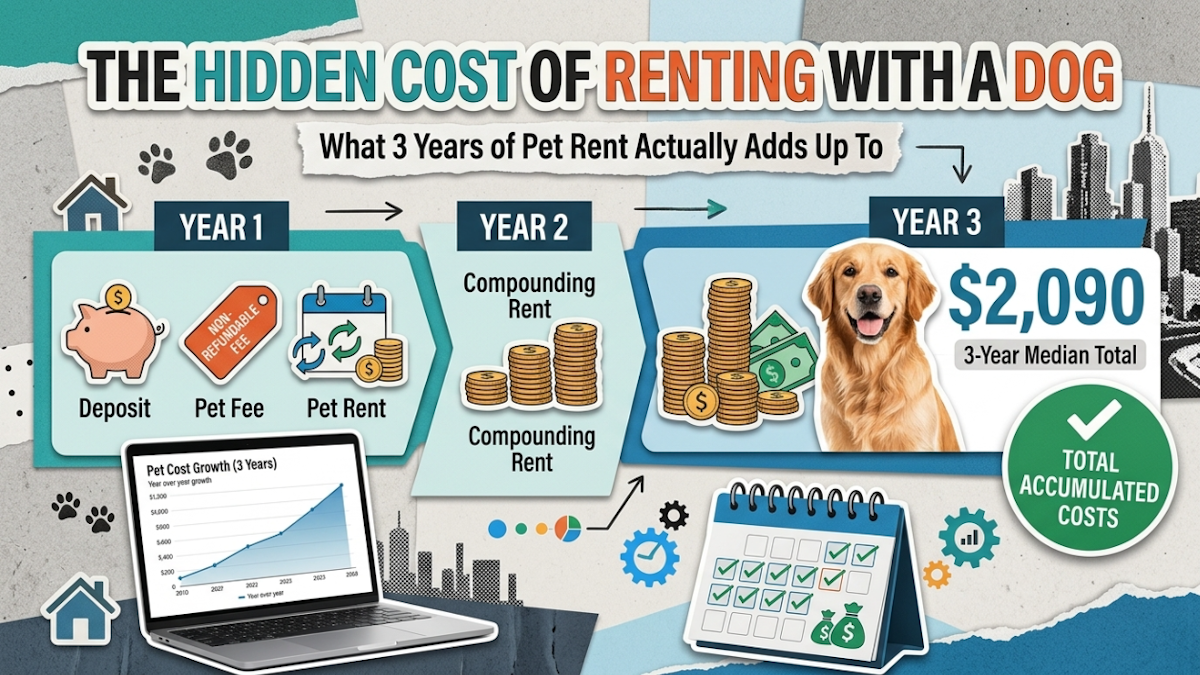
You found the apartment. Good size, decent neighborhood, landlord seems reasonable. Then you mention you have a dog, and the math starts. A pet deposit upfront. A monthly pet rent line item. Maybe a one time pet fee on top. Maybe a per pet charge if you have two.
You sign the lease anyway, because the apartment is right and the dog is family. But six months in, you start adding up what your dog has actually cost you in housing fees alone, and the number stops feeling like a small line item.
This article does the math. The full cost of renting with a dog is not the pet rent line on your lease. It is that line, plus the deposits, plus the fees, plus three years of compounding, plus the cost of every rejection that pushed you into a more expensive apartment than the one you wanted.
What landlords actually charge to let your dog live with you
There are three separate charges that show up on pet friendly leases, and most renters do not realize they are three separate things until they read the fine print.
| Fee Type | What It Means | Typical Range |
|---|---|---|
| Pet Deposit | One time payment, often refundable if your pet causes no damage | $200 to $700 |
| Pet Fee | One time payment, non refundable, in addition to the deposit | $100 to $500 |
| Pet Rent | Recurring monthly charge added to base rent every month of your lease | $25 to $75 per month |
The pet deposit is the one most renters expect. It sits next to the regular security deposit and behaves the same way. You pay it on move in. You may or may not see it again on move out, depending on whether your dog chewed a baseboard.
The pet fee is the one that catches people off guard. It is non refundable by design. You pay it, the landlord keeps it, and there is no audit at the end of the lease. Some properties charge a fee instead of a deposit. Others charge both.
Pet rent is the one that does the real damage over time. It is not large in any single month. Twenty five dollars sounds like a coffee shop tab. Fifty dollars sounds like a streaming subscription. But it never ends. It runs every month of every lease year, and it scales with whatever pet inflation your local market is willing to support.
Average pet rent in 2026
National data from rental industry trackers puts the average pet rent in the United States somewhere between $25 and $50 per month in 2026, with a national average sitting close to $35 in most surveys.
Large cities run higher than small cities. Luxury buildings run higher than older walk ups. Properties that allow large breeds often charge more than those that cap weight. Some buildings charge per pet, so if you have two cats or a dog and a cat, you pay the line twice.
Pet rent also tends to increase year over year, the same way base rent does. Annual increases of $5 to $15 per month are common when leases renew. A renter who started at $30 in year one may be at $40 by year two and $50 by year three, even if nothing about the apartment or the pet has changed.
The three year math
Here is what three years of renting with a dog actually looks like in a median market, using midpoint figures that match current national averages.
Year 1
- Pet deposit on move in: $400
- Non refundable pet fee on move in: $250
- Pet rent at $35 per month for 12 months: $420
- Year 1 total: $1,070
Year 2
- Pet rent at $40 per month after a typical $5 annual increase: $480
- Year 2 total: $480
Year 3
- Pet rent at $45 per month after another typical increase: $540
- Year 3 total: $540
Three year running total: $2,090
Best case, if the deposit comes back in full on move out because your dog never scratched a door, you recover $400 and your real out of pocket cost is $1,690. Worst case, the landlord deducts from the deposit for normal wear, and you pay close to the full $2,090.
That is the cost of renting with a dog in a market where pet rent is moderate. It is not a luxury market. It is not New York City. It is the middle of the country with median fees.
What happens in expensive markets
In high tier rental markets, the numbers shift quickly.
| Market Tier | Typical Deposit | Typical Pet Rent | Annual Pet Costs | 3 Year Total (Approx.) |
|---|---|---|---|---|
| Low tier (smaller cities, suburbs) | $200 to $400 | $20 to $40 | $700 | $1,800 to $2,100 |
| Median tier (most US metros) | $300 to $500 | $25 to $50 | $900 | $2,000 to $2,500 |
| High tier (NY, CA, MA, WA, NJ, CT, MD, HI) | $400 to $700 | $40 to $75 | $1,200 and up | $3,200 to $4,000 |
A renter in a high tier market who keeps a dog through three lease years can easily pay $3,500 or more in pet related housing fees alone, before counting food, vet visits, grooming, or any of the actual costs of dog ownership.
This is housing only. This is just what your landlord charges you to share your own apartment with your own dog.
The hidden cost most renters forget
The numbers above only capture the fees that appear on a lease. There are at least three more costs of renting with a dog that never show up on paper.
The breed rejection tax. Many buildings ban specific breeds outright. Pit Bulls, Rottweilers, German Shepherds, Dobermans, Chow Chows, Akitas, and Mastiffs are commonly banned. A renter with a banned breed cannot just choose a more expensive apartment. They are filtered out of the affordable options entirely and forced into a smaller pool of permissive buildings that typically charge above market rent.
The relocation premium. When the right apartment says no pets and there is no negotiating, renters either give up the apartment, move farther from work, or accept a worse unit at the same price point. The hidden cost is everything they would have paid less for if their dog had not been part of the equation.
The lost opportunity cost on deposits. A $400 pet deposit sits in a landlord escrow for three years and earns the renter nothing. Even at modest interest rates, that capital tied up across multiple leases over a renting lifetime adds up to real money the renter never gets back in interest.
These do not appear on any spreadsheet, but they are part of the true cost of renting with a dog and they fall on the same group of renters every time.
How this compares to actual pet ownership costs
The cost of owning a dog in the United States, not counting housing fees, generally runs between $1,000 and $4,000 per year depending on the size of the dog, food choices, vet care, and grooming. Insurance, dental work, and emergencies push it higher.
Add three years of housing fees on top of that, and a renter with a dog in a median market is paying $2,000 more for their dog than a homeowner with the same dog. Not because the dog costs more. Because the landlord charges more.
That gap is one of the quieter cost of living inequalities in American renting. Homeowners with pets do not pay pet deposits. Homeowners with pets do not pay monthly pet rent. The fee structure that takes thousands of dollars from renting families over the course of three lease years simply does not exist on the ownership side of the housing market.
The legal exemption most renters never hear about
The cost of renting with a dog is the default. It is not the only option.
Federal law, specifically the Fair Housing Act, requires landlords to make reasonable accommodation for tenants with qualifying mental health conditions whose animal provides emotional support related to that condition. The law treats that animal differently from a pet. It is classified as an assistance animal, and under federal housing rules, a landlord cannot charge pet deposits, pet fees, or monthly pet rent for an assistance animal. Breed restrictions and weight limits do not apply either.
The protection applies in all 50 states. It is federal, not state law, which means it overrides whatever the landlord normally charges.
To claim the protection, the tenant needs documentation from a licensed mental health professional confirming that the person has a qualifying condition and that the animal provides emotional support related to it. The condition list is broader than most people assume. Anxiety, depression, post traumatic stress, panic disorder, obsessive compulsive disorder, and several others qualify if they meaningfully limit daily life.
For a renter currently paying $40 in pet rent and $400 in deposit costs across a three year lease, the math on legitimate ESA documentation is straightforward. The fee structure described above ends.
Why this matters for renters reading their next lease
If you are signing a new lease in the next six months, the cost of renting with a dog deserves a closer look than most renters give it. The pet rent line in particular has a habit of looking small in isolation and large in aggregate.
A few things worth doing before you sign:
- Add the full three year pet cost to the total cost of the apartment in your head, not just the monthly rent.
- Ask in writing whether the pet deposit is refundable, what conditions trigger deductions, and what the landlord considers normal wear.
- Confirm whether the non refundable pet fee is separate from the deposit, and whether it is a one time charge or recurring annually.
- Check what the landlord's annual pet rent increase has been over the last two years on this property.
- If you have a qualifying mental health condition, look into whether a valid ESA letter from a licensed therapist would apply to your situation before the lease is signed. The protections are easier to invoke at lease start than to renegotiate mid lease.
The renters who pay the most over time are not the ones with the most expensive dogs. They are the ones who never added the small monthly numbers across the full length of their tenancy and never knew there was a federal exemption that could have changed the equation.
The cost is real, and so are the options
Three years of renting with a dog in a median market runs between $2,000 and $2,500 in housing fees alone. In high tier markets it runs closer to $4,000. Across a full renting lifetime, those numbers compound into five figure totals that most renters never tally because the fees arrive in small monthly slices.
The cost of renting with a dog is one of the most predictable expenses in American housing and one of the least discussed. Knowing the actual numbers, before the next lease is signed, is what separates renters who keep paying the default from renters who know exactly which line items they are agreeing to.
For renters managing a qualifying mental health condition, the Fair Housing Act exemption is worth examining with a licensed professional. RealESALetter.com works with state licensed therapists who evaluate eligibility and issue valid ESA documentation when clinically appropriate, with protections recognized in housing accommodation requests across all 50 states.