What Airlines Allow Service Dogs in 2026: Delta, Southwest, United and More
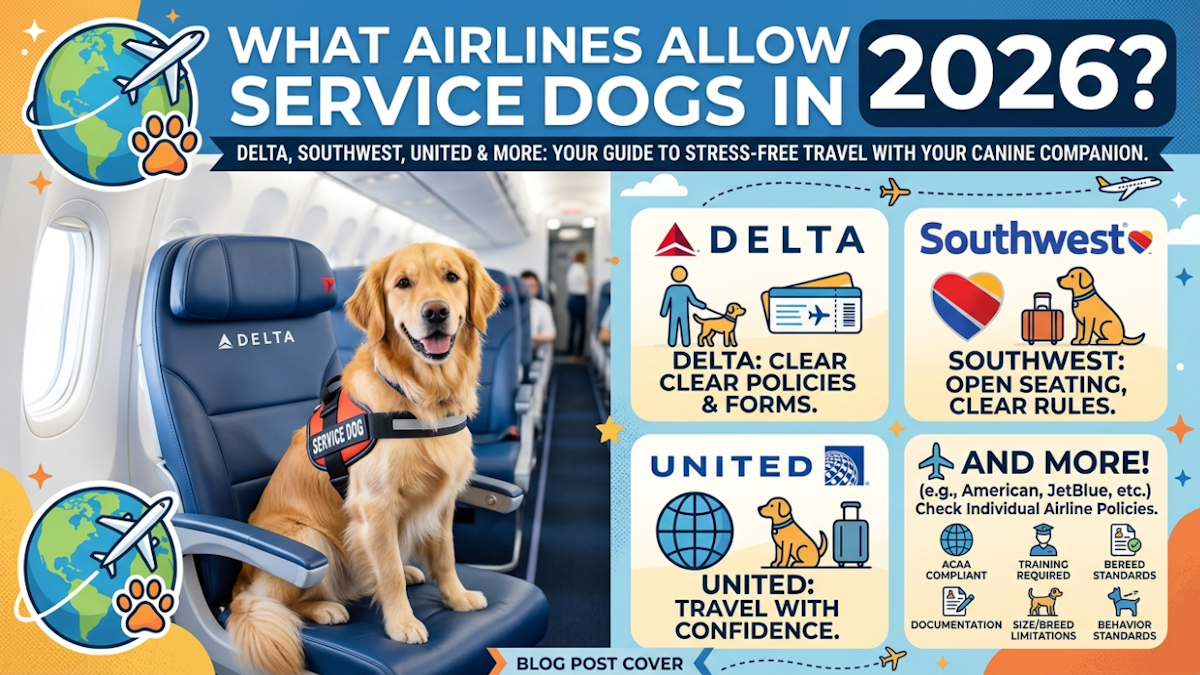
If you are planning to fly with a service dog in 2026, the rules look very different from what they were just a few years ago. The January 2021 Department of Transportation rule change under the Air Carrier Access Act redrew the entire picture of who can bring an animal into an aircraft cabin and under what conditions. Airlines that once accepted emotional support animals with a letter and a form now require trained service dogs only, and each carrier applies that requirement with its own specific documentation, notice, and behavior standards. Getting this wrong does not just mean a bad check-in experience. It can mean your dog gets denied boarding entirely.
This guide breaks down exactly what Delta, Southwest, United, American, JetBlue, Alaska, Spirit, and other major carriers require in 2026, what documentation you need to prepare, and how to make sure your travel goes smoothly from booking to landing.
The 2021 DOT Rule Change: Why Everything Shifted
Before the January 2021 rule change, airlines were required under the Air Carrier Access Act to accommodate a broad range of support animals, including emotional support animals, with relatively minimal documentation. The resulting chaos, including incidents involving large animals, animals with no training, and widespread documentation fraud, pushed the DOT to act.
The Final Rule that took effect in January 2021 made three major changes:
- Service animals for air travel are now defined exclusively as dogs individually trained to perform tasks for a person with a disability. No other species qualifies, and untrained comfort animals do not meet the standard.
- Emotional support animals lost their protected status under the ACAA. Airlines are now free to treat ESAs as regular pets, subject to standard pet fees and carrier restrictions.
- Airlines must accept a standardized DOT Service Animal Air Transportation Form as the primary documentation. Some carriers also require a separate Relief Attestation Form for flights over eight hours.
The practical result is that only Psychiatric Service Dogs and other trained service dogs now fly free in the cabin as a matter of federal right. Every other animal travels under whatever pet policy the airline has set, with fees attached.
Airline-by-Airline Service Dog Policy Comparison for 2026
Here is a consolidated view of how the major U.S. carriers handle trained service dogs and former ESA travelers in 2026:
Airline | Service Dogs Fly Free | Advance Notice Required | Key Documentation |
Delta | Yes | 48 hours before departure | DOT Service Animal Form, behavior attestation |
Southwest | Yes | 48 hours before departure | DOT Service Animal Form required at gate |
United | Yes | 48 hours before departure | DOT Service Animal Form, up to 2 dogs per passenger |
American | Yes | 48 hours before departure | DOT Service Animal Form, one dog per passenger |
JetBlue | Yes | 48 hours before departure | DOT Service Animal Form, behavior verification |
Alaska | Yes | Recommended at booking | DOT Form and health certificate, no breed restrictions for PSDs |
Spirit | Yes | 48 hours before departure | DOT Service Animal Form, no brachycephalic breeds |
Hawaiian | Yes | 48 hours before departure | DOT Form plus proof of training and health |
Delta Air Lines Service Dog Policy
Delta was one of the first major carriers to push back aggressively against undocumented ESA travel and has maintained strict standards since 2021. In 2026, Delta accepts only trained service dogs in the cabin at no charge. Psychiatric Service Dogs are included under this policy provided the handler submits the correct documentation.
What Delta requires:
- Completed DOT Service Animal Air Transportation Form submitted at least 48 hours before departure through Delta's online accessibility request portal.
- For flights over eight hours, a separate Behavior and Sanitation Attestation confirming the dog can manage flight duration without a relief break in the cabin.
- The dog must sit at the handler's feet without blocking the aisle or the emergency exit row.
- One service dog per passenger. Delta does not allow two service dogs per traveler.
Delta has the right to deny boarding to any dog displaying aggressive behavior, regardless of documentation status. The documentation confirms training and health. Behavior on the day of travel is evaluated separately.
Southwest Airlines Service Dog Policy
Southwest stopped accepting emotional support animals on March 1, 2021, and has maintained that position since. Under the Southwest Airlines service dog policy in 2026, only dogs trained to assist with a specific disability are permitted in the cabin at no charge. ESAs traveling as pets must meet size restrictions and pay standard pet fees.
What Southwest requires:
- DOT Service Animal Air Transportation Form presented at the gate or ticket counter before boarding.
- The dog must remain under control at all times, either on a leash or in a harness.
- The animal must fit in the space at the passenger's feet without blocking the aisle.
- No other animal species are accepted as service animals. Dogs only.
- Pets traveling under the standard pet policy are limited to dogs and cats, with no flights to Hawaii or international routes.
Southwest does not currently impose breed restrictions on trained service dogs, but behavioral standards are strictly enforced. A dog that acts aggressively at the gate will not board regardless of paperwork.
United Airlines Service Dog Policy
United's approach through the United Airlines service dog policy is among the more detailed of the major carriers. United allows up to two trained service dogs per passenger in the cabin at no charge, which is more permissive than most carriers on that specific point.
What United requires:
- DOT Service Animal Air Transportation Form submitted at least 48 hours before departure.
- Dogs must fit entirely within the passenger's foot space. They cannot occupy a seat.
- Brachycephalic (snub-nosed) breeds including Bulldogs, Pugs, Boxers, and Boston Terriers are not accepted due to health risks during air travel. This breed restriction applies to service dogs as well as pets.
- Health certificates are encouraged for domestic flights and required for international travel.
- United's PetSafe cargo program is currently suspended except for active military and Foreign Service personnel on official orders.
ESAs traveling as pets on United are subject to a $150 fee per one-way flight, a 15-pound weight limit for cabin travel, and standard carrier size restrictions.
American Airlines Service Dog Policy
American Airlines stopped accepting ESAs as of February 1, 2021. In 2026, the carrier accepts only trained service dogs and Psychiatric Service Dogs in the cabin without fees. American is strict about the one-dog-per-passenger limit, unlike United.
What American requires:
- DOT Service Animal Air Transportation Form submitted a minimum of 48 hours before the flight.
- One service dog per passenger. No exceptions to this limit.
- The dog must remain leashed and under the handler's control at all times during the flight.
- American requires the dog to sit at the handler's feet without encroaching on neighboring passenger space.
- For international travel, destination country import rules apply and are the passenger's responsibility to meet.
Pets traveling under American's standard policy are accepted in-cabin for a $125 per kennel fee. Pets must remain in an approved carrier that fits under the seat in front.
JetBlue and Alaska Airlines: What to Know
JetBlue | Alaska Airlines |
ESAs reclassified as pets as of January 2021 | ESAs reclassified as pets as of January 2021 |
Trained service dogs fly free with DOT form | Trained PSDs and service dogs fly free with DOT form |
48 hours advance notice recommended | Advance notice recommended at time of booking |
One service dog per passenger | No breed restrictions for PSDs |
Brachycephalic breeds restricted in cabin and checked baggage | Behavior standards strictly enforced regardless of documentation |
Small cabin pets: $125 fee, max carrier dimensions 17x12x8 inches | Small cabin pets accepted, fees vary by route |
No cargo pet travel available | Cargo travel available for larger pets in IATA-approved kennels |
The DOT Service Animal Air Transportation Form: What It Covers
Every airline on this list requires the same foundational document: the U.S. Department of Transportation Service Animal Air Transportation Form. Understanding what it asks for and how to complete it correctly before you reach the airport is the single most important thing you can do to prevent a travel disruption.
The form requires you to attest to the following:
- Your identity as the handler and your disability status. You do not need to specify your diagnosis.
- The dog's identity, including name and description.
- Current vaccination status of the animal.
- That the dog has been trained to behave appropriately in public settings.
- That the dog will not need to relieve itself during the flight, or that it can do so in a sanitary manner if the flight exceeds eight hours.
The form is available directly from the DOT website. Most airlines also provide it through their accessibility or special services booking portal. Complete it digitally, save a copy to your phone, and email yourself a backup. Paper copies are accepted at most gates but digital submission in advance is the cleaner option.
Psychiatric Service Dog vs. Emotional Support Animal: What Changes for Air Travel
For people whose mental health condition is severe enough to require task-specific support, upgrading from ESA status to a psychiatric service dog can restore the air travel protections that were removed in 2021. Here is how the two statuses compare in the air travel context:
Factor | Psychiatric Service Dog (PSD) | Emotional Support Animal (ESA) |
Cabin access | Yes, free of charge under ACAA | No. Treated as a regular pet |
Pet fee | None | $75 to $150 per one-way flight depending on airline |
Documentation needed | DOT Service Animal Form, task training verification | ESA letter only (for housing and other non-air uses) |
Size restriction | No size limit for cabin access | Carrier must fit under seat |
Training requirement | Must be task-trained for a specific disability | No specific task training required |
Breed restrictions | No federal breed restrictions, varies by airline | Standard pet policy breed restrictions apply |
Practical Tips for Flying With a Service Dog in 2026
Getting the documentation right is the foundation. But the experience from check-in to landing involves more than paperwork. These are the steps that consistently make the difference between a smooth trip and a stressful one:
- Submit your DOT form as early as possible, not at the last minute. Airlines process accessibility requests before the day of travel and having a confirmation on file protects you if there is a dispute at the gate.
- Book a bulkhead or exit row seat where leg space is greater. Your dog needs to fit at your feet, and larger dogs benefit significantly from the extra floor space. Note that some airlines restrict service dogs from exit rows for safety reasons, so confirm with the carrier.
- Carry backup documentation. Have your DOT form, any training records, and a copy of your PSD or service dog documentation saved locally on your phone, not just in the cloud. Gate agents cannot wait for you to get a signal.
- Arrive early. Service dog check-ins at most carriers require a secondary verification step at the gate or ticket counter. Building in an extra 30 minutes prevents this from becoming a problem.
- Know your dog's limits. A dog that handles your daily environment well may respond differently to airport crowds, security procedures, and pressurized cabin noise. Practice exposure to high-stimulation environments before a long trip.
- Check destination country rules for international travel. The DOT form covers your domestic departure, but entry into another country requires that country's own import documentation, health certificates, and sometimes advance clearance. This is entirely separate from the airline's requirements.
The Bottom Line
In 2026, every major U.S. airline allows trained service dogs and Psychiatric Service Dogs to fly in the cabin at no charge, provided the handler submits the correct DOT documentation with sufficient advance notice. Emotional support animals no longer carry the same access rights on flights and must travel as standard pets with fees and size restrictions attached. If you have a trained service dog, preparing your paperwork early, knowing your specific airline's rules, and arriving with time to spare will get you through the process without friction. If your situation involves a mental health condition that could qualify for PSD documentation, getting that evaluated and properly certified through a licensed provider like RealESALetter.com is the starting point for restoring those air travel protections.
Need a valid letter for housing protections while your travel plans come together? An ESA letter online from a licensed mental health professional still covers your Fair Housing Act rights fully, even if it no longer applies to flights. Getting both types of documentation sorted through the right provider keeps all your bases covered regardless of where you are going.